


Dedicated Servers vs Cloud Hosting: When Liquid Web Makes the Difference

Choosing between dedicated servers and cloud hosting is one of the most important infrastructure decisions a business can make. Each option offers advantages, but the right choice depends on performance requirements, workload consistency, and operational priorities.
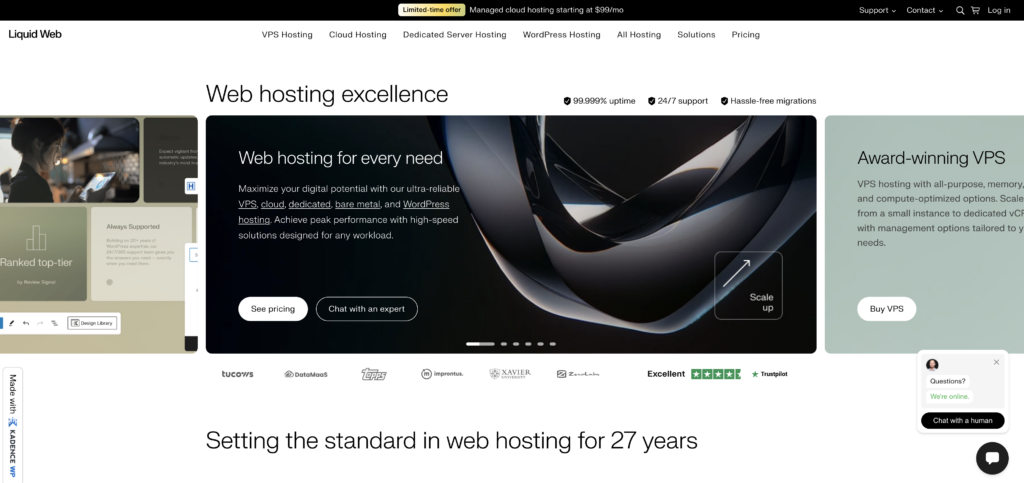
Liquid Web offers both dedicated and cloud solutions designed for businesses that demand reliability, security, and managed support.

Understanding Dedicated Servers
Dedicated servers provide exclusive access to physical hardware.
This means all CPU, memory, and storage resources are reserved for a single customer. Performance remains consistent regardless of traffic fluctuations on other sites.
Dedicated servers are commonly used for:
- High-traffic ecommerce sites
- Custom enterprise applications
- Databases requiring stable performance
Understanding Cloud Hosting
Cloud hosting distributes workloads across virtualized environments.
It offers flexibility and scalability, making it suitable for applications with variable traffic patterns.
Cloud environments can scale resources up or down quickly, helping businesses adapt to demand changes.
Performance Trade-Offs Between the Two
Dedicated servers excel in predictable performance. Cloud hosting excels in scalability.
For workloads with consistent high demand, dedicated servers often outperform cloud setups.
For applications with fluctuating usage, cloud infrastructure offers agility.
Liquid Web optimizes both options to minimize common performance bottlenecks.
Security Considerations
Security models differ between dedicated and cloud hosting.
Dedicated servers provide physical isolation, which can simplify compliance and risk management.
Cloud hosting relies on logical separation, which requires strong configuration and monitoring.
Liquid Web integrates security controls into both environments, reducing exposure regardless of architecture.
Managed Infrastructure as a Differentiator
Infrastructure management often determines success more than hardware choice.
Liquid Web provides managed services that cover:
- Server updates
- Security patches
- Monitoring and alerts
- Technical support
This allows teams to focus on applications rather than infrastructure maintenance.
Compliance and Business Requirements
Some industries require strict compliance with data protection standards.
Dedicated servers may simplify compliance for certain workloads, while cloud hosting can still meet requirements with proper configuration.
Liquid Web supports compliance-ready environments for regulated industries.
Cost Predictability and Scaling
Dedicated servers offer predictable monthly costs.
Cloud hosting costs may fluctuate based on usage.
Businesses must balance budget stability against scaling flexibility.

Choosing the Right Option
The choice between dedicated and cloud hosting depends on:
- Traffic consistency
- Security requirements
- Compliance needs
- Internal technical resources
Liquid Web helps businesses evaluate these factors and align hosting with operational goals.
Why Liquid Web Fits Both Models
Liquid Web does not force a one-size-fits-all approach.
Its infrastructure supports both dedicated and cloud solutions with the same focus on uptime, security, and managed support.
This flexibility allows businesses to evolve without switching providers.
Final Thoughts
Dedicated servers and cloud hosting serve different purposes, but both benefit from strong infrastructure management.
With Liquid Web, businesses gain hosting solutions built for performance today and scalability tomorrow.
FAQ
Does Liquid Web offer both cloud and dedicated hosting?
Yes. Liquid Web supports both hosting models.
Which option is better for ecommerce?
High-traffic stores often benefit from dedicated servers.
Is managed hosting included?
Yes. Liquid Web focuses heavily on managed infrastructure.
Can businesses switch between models?
Yes. Liquid Web supports infrastructure transitions as needs evolve.


